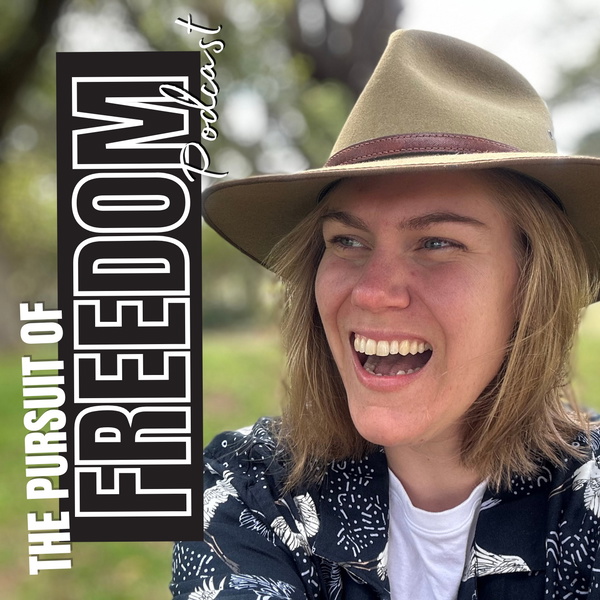
Resources mentioned in this episode:
- Start With Why by Simon Sinek
- Brené Brown, Clear is Kind
Get in touch with today's guest:
'Til next time,
TRANSCRIPT
[00:00:00] Rosie: Hello, hello, and welcome to episode 38 of the Pursuit of Freedom podcast. I am finally back in the swing of releasing my conversations with my wonderful, wonderful guests. I definitely got overwhelmed for a while there, keeping up with editing and posting, and just had to be kind to myself and have a break.
[00:00:22] And all I ask for is for my wonderful guests to I hope you enjoy this episode, like, it was recorded over six months ago, so a while. And unfortunately, the recording kept, um, fucking up, which is very annoying. So I have tried to patch together the conversation. Unfortunately, there's probably 20 minutes of content that was lost.
[00:00:53] So that's really shitty, but it's still an awesome, awesome, awesome conversation. Please forgive any bits that might [00:01:00] feel a bit jilted. It's probably because I just haven't done a fabulous job editing it, but I know you're going to get value from this. So buckle up. I'll catch you at the end of the episode.
[00:01:12] G'day and welcome to the Pursuit of Freedom podcast. I'm your host, Rosie Burrows, and I'm on a journey to find my freedom so that I can help you do exactly the same. Join me each week as I share the stories of everyday people who've found their own path to freedom. I'm not going to focus on job titles and accolades because I don't care about that stuff and neither should you.
[00:01:34] I want to uncover what truly makes you tick. Who are you? When you step away from society's expectations and follow your heart. I still haven't figured it out yet. Have you? Either way, buckle up because it's going to be one hell of a ride. Joining us today is the wonderful Becca Briggs. And often I introduce my guests by [00:02:00] talking about what they do, but I'm going to skip that today because I want to dive into who you are as a person.
[00:02:07] Becca, now this is a huge question, but it's kind of like story time. So can you take us back to Becca as a little girl and talk us through?
[00:02:18] Becca: Oh man, that is a big question. Yeah. Um, as a little girl. So. Yeah, um, little, little Becca was very misunderstood, um, from a very young age, I have always considered myself to be, uh, creative, be very sensitive.
[00:02:40] I always wanted to be an artist and help people was kind of, from being young, just, you know, I want to help people and I want to make art. That was always my focus. Had to grow up from a really young age. Um, just my, my parents split. I lived with a single mom who worked all sorts of different hours, had some [00:03:00] babysitters, took care of myself a lot of the times, um, and, and really had to, In a lot of ways, become my own friend.
[00:03:09] I feel like from a young age, like I always struggled with making friends. I always felt like I didn't really belong anywhere. Got bullied a lot and so never felt like I belong. So really had to find my own companionship in that way. And then, you know, puberty and all the hormones hit and you really don't feel like you belong anywhere.
[00:03:29] Um, experience a lot of. A similar, similar feeling of just not belonging and like there was something wrong with me of getting severely depressed when I was 12. You know, growing up in chaotic households, like my mom had gotten remarried and like. That was not a great situation, and so, still kind of having to fend for myself.
[00:03:54] I always did feel like I had kind of the split life between being at my mom's and being at my [00:04:00] dad's. So then when I moved in with my dad, um, it was a very more controlled environment, very, um, very conservative, very religious household. These are the rules, this is how you need to live your life, this is who you need to be.
[00:04:13] And so, really, that kind of gave the framework of like, Oh, okay, this is who I am. Until realizing, I don't think that this is actually who I am. And so, after moving out, uh, on my own for college, and then spending all my 20s really trying to figure out like, Okay, who actually am I? What am I about? What, you know, from, from childhood, I think a lot of us, Our core is from who we are as children, but then our life experiences shape us in so many ways.
[00:04:41] So, like, who, uh, who is Becca? Who is Becca here to be? What am I here to do? All of these components that have made up who I am in this present
[00:04:53] Rosie: place. That's something I really relate to, like a huge chunk of my life has [00:05:00] been figuring out or trying to answer the question, who am I? And I feel like it's an ongoing journey, but I definitely feel a lot clearer than I did 10, 15 years ago.
[00:05:11] But I'd love to hear your thoughts on how you navigated that. Like how have you figured out who you are?
[00:05:21] Becca: So, big part for me has been seeing the patterns and consistencies. Um, I, I will say that is a gift, natural gift that I have is being able to identify patterns, uh, and things, but seeing, okay, through all these periods of my life, what has stayed the same?
[00:05:38] Throughout these different chapters and changes that I've experienced or things that have resonated and things that have fallen by the wayside, what has always stayed the same? Those key components. That are always there within me. And they might show up in different ways, but they're always there. So like, for example, is I, you know, I say I've always been really creative.
[00:05:58] The methods that [00:06:00] I've used for creativity have changed, continue to change. But creativity is still a very strong value to me and creative expression and, and being creative in your lifestyle and how you express yourself will always be important to me. So I think that's part of the building block of what makes me who I am.
[00:06:19] Um, another thing is, um, using, I use, uh, within coaching that I help people with, I use a tool called human design and human design has really helped me to see the parts of myself that I was always told were wrong about me or told that this was incorrect or this needed to be changed and seeing, okay, what is actually natural for me?
[00:06:47] And, and embracing those things instead of thinking they need to be changed.
[00:06:53] Rosie: Yeah. And can you tell us more about human design? Because I know for me, it's not something I'm over overly [00:07:00] familiar with. And in case some of our listeners are in the same boat, can you unpack it a bit for us?
[00:07:05] Becca: Yeah, of course. Um, so human design is a tool that uses a blend of various modalities including astrology, Chinese I Ching, uh, chakras, the Kabbalah tree of life, with genetics, biochemistry, and quantum physics to give you your unique energetic blueprint of the role you're here to play in life, um, what you're naturally here to share with others, um, the areas that you might have some conditioning or you're, you know, are learning from others and how you make the most aligned decisions for yourself.
[00:07:38] Rosie: So how has human design changed your life?
[00:07:43] Becca: Oh my God, so many ways. Um, first and foremost was learning. Um, so you're kind of, your first step in learning human design would be learning what your type is. So there's Uh, five different types that you can be based on certain energetic centers that you have [00:08:00] defined or undefined.
[00:08:01] And realizing that for me, uh, I'm a type that's known as a reflector. That makes up 1 percent of the population. So literally talking about like not feeling like you fit in anywhere, I'm like, Oh, that, that tracks and a lot of it. So what makes a reflector is not having any defined centers. So really having this.
[00:08:23] influence by the people that you're around and how you feel. So a lot of, you know, this questioning, who am I, or what is for me and what isn't for me. And, you know, why do I feel like this around this person and this around this person always, I would say one of my biggest struggles growing up was always felt like I didn't know who I was, or I didn't have any kind of foundation of me as a person because I felt so influenced by different people all the time, but then realizing.
[00:08:54] Oh, that's actually correct for me. It's like in my DNA to take [00:09:00] in little samples from the people that I'm around and the experiences I have to be a blend of things and reflect back to other people, certain things, it's okay for me to not have this like strong, solid foundation of who I am. Like I mentioned earlier, it's like, I feel like I have the core components that make me who I am and that's what I'm here to share with others.
[00:09:20] Rosie: Uh huh.
[00:09:21] Becca: But it's okay to be a bit of a chameleon and
[00:09:26] Rosie: Yeah.
[00:09:27] Becca: And change and adapt with what you're experiencing.
[00:09:31] Rosie: I totally agree. You know, I'm not the same person today as I was a year ago. And to me, that's a sign of personal growth. And that's important to me. Yeah. You know, I think there's, you know, there's some big voices out there such as Simon Sinek.
[00:09:48] I don't know if you're familiar with him, but he is all about find your why. That's what he preaches, right? And he says you only have one why and it can never [00:10:00] change. And I kind of push back on that. What are your thoughts? Yeah, I
[00:10:04] Becca: don't know. I don't know that I agree with that. Um, I think for some people, sure, like you might have one why and I think, you know, maybe if you want to get really particular about it, you could label something as one why for everyone, but I think we're so multifaceted and we go through Chapters and changes and again, like different experiences can influence us so much is
[00:10:32] Rosie: why can't we have more than one on this topic of, you know, why do you only have to do one?
[00:10:39] I want to dive into what you do for work because when we first met, you told me you currently have five jobs. Now that is totally against. The status quo and I fricking love it. So can you tell us what's going on there?
[00:10:58] Becca: A lot, a lot [00:11:00] is happening. Um, yeah. So, and that's one thing I'll say really quick before I get into it is that was one thing that it is abnormal.
[00:11:11] You know, most people just have one career, one, one job, one path. And that's something that for a long time, I personally was like, I've always, I've always liked doing more than one thing or kind of jumping from thing to thing and if I can do so without burning myself out is the key there, but Took a while to really accept that in myself of being okay with having Juggling as much as I do.
[00:11:38] Um So yeah, first and foremost, I have my own life coaching business Uh, which kind of, as I mentioned, is like, I want to help people figure out kind of who they are and what kind of life they want to live and how to live in alignment to what's actually correct for them. Um, so I do, do my coaching, [00:12:00] um, I work as an office manager for a wellness center that I coach out of.
[00:12:07] I am a manager of a bookstore slash espresso bar. And then I have two, uh, virtual assistant jobs right now as well. Wow.
[00:12:18] Rosie: I think that's so cool.
[00:12:20] Becca: So I was gonna say, we want to get really crazy. I also have done freelance modeling for the last It's almost 14 years now. So I don't do it regularly, so I don't really count it, but that is always on the back burner as another.
[00:12:37] Rosie: Yeah. Career. And just recalling some of the things you, you've told me that you've done over the years. There's pottery, childcare, preschool photography, working in a vet clinic, web design. And I feel like that's such an important part of discovering who you are and what you like, and for anyone listening who's feeling stuck and kind of [00:13:00] don't know what the next step is, that is okay.
[00:13:03] We've all been there. Just try something and if you don't like it, move on. And you
[00:13:11] Becca: might end up like Becca and do
[00:13:13] Rosie: five things.
[00:13:14] Becca: All of the things. That's one thing that I felt really blessed with. I thought about that when I got the job originally at the bookstore was I made a list of all the jobs that I've had just to reflect on and was like, there's so many jobs that you're, I think we'll see and we'll be like, Oh, that would be a fun job, but then we don't actually take them.
[00:13:37] And I'm like, I'm the type of person that when I've seen those pop up, I'm like, Oh, I'll do that. Like, Yeah, working at a, a paint room pottery studio doing preschool photography, you know, working as an afterschool teacher, like kind of fun jobs. And like the bookstore, I'm like, I'd work in the bookstore, like totally.
[00:13:56] And I think a lot of times, I don't know if it's, we [00:14:00] psych ourselves out because it doesn't seem like a good long term plan or, you know, realistic, or I'm not entirely sure for like, why people don't. Do it, but I've always just been the type of person I'm like, I want to spend all of my time somewhere. I want it to be something that I halfway enjoy.
[00:14:20] Like, I don't want to just sit in a cubicle somewhere doing work that doesn't do anything for me. Like, what's the point? And I've done that. I've tried that a couple times and usually I last like three months before I get really depressed. And it's like, I don't want to feel like I'm like this robot monkey just doing tasks for people with no purpose or fun or skill.
[00:14:41] And so just that, you know, not knowing what's going to come next, but just taking the chance of like this, if anything, this will just be a fun experience. And that for me is enough.
[00:14:51] Rosie: Yeah. Yeah. And what, what would you say to people? Cause there's a lot of people out there who think this and I've been guilty of [00:15:00] it in the past.
[00:15:01] You say, well, I can't get out of this. My current job or my current situation because, you know, that's just the way life is, or I need that secure paycheck or whatever it is. What would you say to those people?
[00:15:17] Becca: So a couple of things always come to mind when people, you know, say, well, like, I can't do that.
[00:15:22] Or, you know, I can't leave my job. Well, who says? Like, you know, and then I've been guilty of myself in the past of, of being, you know, feeling like I need to take a job for job security, like I need this career, I need this and that. Um, the thing is, it's kind of a false sense of security because you could get laid off at any point in time, you know, and I think in a lot, like unfortunately in a lot of cases is like, Your job doesn't care about you.
[00:15:50] They, you know, you need them more than they need you. They can replace you if they ever decide to. And, You know, if you're not living up to their [00:16:00] expectations, you're gone. So you just stay doing what they want you to do for this false sense of security when there's like, anything is possible. And like, I, even though my life is, is wild, it's not even as wild as some other people that I know that like are able to, you know, they just travel full time because they love traveling.
[00:16:24] So they have all these different jobs or have very obscure jobs. It's the. So I guess this would be like the third thing I would say is the I think we don't give ourselves enough credit for how resourceful we can be. So, for example, if you were to get laid off from your job, like, well, what would you do?
[00:16:41] Would you just sit there? No, you'd figure something else out. But like, wouldn't it be better to have the the power To do that for yourself now, like, I'm not figuring something out because I have to. I'm figuring out what I want to do because I want to and because I can. And I'm seeing what other options are there [00:17:00] for me that a lot of times people don't even consider as being possible for them.
[00:17:05] Um, I, I know one, uh, one girl that I know who literally travels the world full time and you can find work study Jobs anywhere. So she'll go, she just went to like the Galapagos for a few weeks and did like a work trade and it's, you know, you get free housing and food, you know, stipends and if that's what you want to do, why not do it?
[00:17:32] And it, it can feel safe to just stay here, but it's, it's really not any safer than it is doing what it is that you want to do. I totally agree.
[00:17:46] Rosie: And I refer to it as the secure job fallacy because it is, it's just, it's not real. Like you said, they can let you go at any time, um, and you need them more than they need you.
[00:17:57] It's, it's so true. And [00:18:00] I think the trap we fall into is we are scared of change often because we're scared of failure. So we want to avoid the fear of failure. We like avoiding pain as humans.
[00:18:18] What's the cost of staying how we are now? Often there is a huge cost. Frame it that way, and it's very easy to make a decision and go, Yeah, I'm changing things right now. Because we're worth it, right? Just dare to dream. Dare to take a chance, and if it doesn't work out, that's okay.
[00:18:39] Becca: Well, that's one thing we talk about a lot in coaching, is that there's no such thing as failure, only feedback.
[00:18:45] So you say like, okay, well, what if I do this and it doesn't work out? Well, then it doesn't work out. Then you, Again, you get resourceful and you figure out your next step, and now you know you don't want to do that, or you know you've learned something from this experience that you want to take with [00:19:00] you, or that's made you better in this certain area, or you discover something that you didn't even know that you loved.
[00:19:06] Yeah. That now you want to pursue. Like, you have no idea what is on the other side of that. But there's no, like, the only failure is to just, like, give up.
[00:19:16] Rosie: Right. Right. Totally agree. And you're not going to know if something's the right choice or if it's going to be what you want to do. Unless you do it, you just got to take a chance.
[00:19:27] And like you said, it is feedback. And knowing what you don't want to do is actually really useful information, because I know for me, yeah, I've often had trouble articulating, one, who I am, But two, what I even want to do, like, and who I am. How do I communicate who I am? I don't even have the words. Is that something you've struggled with?
[00:19:54] Becca: It is. And one thing that has been helpful for me that I've started implementing actually [00:20:00] just in the last couple years is, because it is easier I think to figure out what it is you don't want. But then to say, well, what do I want instead of that? So if I'm not doing this, if I don't have that, what do I have instead?
[00:20:11] Saying it and really claiming it. I think is a big one because a lot of times again, we kind of like downplay it and we're like, Oh, well, that would be really cool. And it's like, but is that something that you really want? Because if you really want it, say I, this is what I want.
[00:20:25] Rosie: Yeah.
[00:20:26] Becca: Um, you know, claim it as yours.
[00:20:28] And then again, I'll say like, get resourceful and find a way to make it possible for you, but really get empowered by what it is that you want, because there's a reason that that resonates with you.
[00:20:39] Rosie: Mm hmm. I feel a big part of that is trusting yourself. You know, our intuition is so powerful and we've got, I really believe we've got the wisdom inside us.
[00:20:53] We just have to tap into that and learn to listen.
[00:20:56] Becca: Yeah. Yeah. We have to trust ourselves. And [00:21:00] it's funny because, you know, we want to know who we are and what's correct for us, but we look outside of ourselves for that validation or the answers or the direction, but. Only we know our experiences, only we know our knowledge, only we know ourselves.
[00:21:14] Nobody else is going to understand us the way that we understand ourselves. So why are we giving this power to everyone else to tell us what is correct for us?
[00:21:24] Rosie: So true. Why are we giving the power to other people? That's such a, such a powerful way of framing it. Like I love that so much, I'm just absorbing it because that's exactly what it is.
[00:21:40] So how would you say. We reclaim that power. How do we do it?
[00:21:46] Becca: So for me and my experience and what I, what I help my clients with is first and foremost, kind of re getting to know yourself. Um, and I do, I love using human design. I like using Myers Briggs and Enneagram, [00:22:00] uh, cause I feel like. These tools, they're kind of like archetype tools, kind of does one of two things.
[00:22:07] One, it helps us understand certain parts of ourselves, our motivations, the way that we process things, the energies that we're here to, to give to others, I think is really important. And it also shows us that, uh, what else is out there. So if we find ourselves comparing ourselves to others, well, like they say, I need to do that.
[00:22:25] Why can't I do this the way that they're doing? Um, one of the things I like about archetype systems is it shows really distinct differences. So, okay, this is probably why this is working for this person, but you're over here and that could be where this disconnect is. So, I think it helps us not compare to other people or expect other people to do things the way that we want to do or expect us to do things the way other people want us to do.
[00:22:50] So really showing those differences. And then the next step is really getting clear on, on your why, on your, your passions, on your [00:23:00] vision, on getting Just absorbing those components of what makes you, you, what do you want for yourself in your life? What are you here to give to the world and Um, I think I mentioned this when we talked before, like, I, I think of the world as a puzzle and we're all our own unique puzzle pieces.
[00:23:22] Um, is kind of how I approach growth and healing and everything in this realm. And so it's, if we're trying to be a different puzzle piece than what we are, the puzzle will never come together. But you are here to be your own piece. And so figuring out what makes your piece you and finding your place in the world, however that looks like, that's correct for you to help bring everything together the way it's meant to be instead of trying to force yourself into a spot that's not yours.
[00:23:52] Rosie: I love that analogy. And I would argue that being our unique selves and really leaning into that. [00:24:00] You know, being that individual puzzle piece so we all fit together. I'd argue that that brings us a sense of belonging. Would you agree with that?
[00:24:11] Becca: I do. I think that the more that we, and it's not in a selfish or narcissistic way or anything like that, but it's like the more that we focus on our own growth and healing and getting good with who we are, the less, uh, Uh, projection we have on others, the, uh, the less reactivity we have the others, there's less of the like unhealthy shadow work ego work happening that's limiting us because we're good with who we are.
[00:24:37] We know who we are and why we do the things that we do that it creates less conflict between people. And we all know our roles in our place that it actually brings a sense of community together. But you, I think we really have to have this strong sense of individualism that builds that community.
[00:24:58] Because if we're trying to build a community of [00:25:00] unhealthy people that are just reacting to each other and expecting everyone to do things the way that they are going to do, or we have too many people that are only focused on themselves, that they're not focused on how they contribute to the greater good.
[00:25:15] Either way is limiting, but if we're focused on ourselves and then finding our place to give that, I think would solve a lot of the, the issues we have in our current society.
[00:25:28] Rosie: Totally agree. And I, I tell a lot of people that they need to put themselves first and women in particular push back on that. And they tell me, that's ridiculous.
[00:25:41] I care about other people. I'm like, yeah, but that's not what I'm saying. Yeah. Totally agree. I'm not saying that shows you don't care. I'm saying you need to put yourself first because you are worth it. And once you put yourself first, all the other things come, right? You start unpacking who you are.
[00:25:59] [00:26:00] You've got more joy in your life. You're bringing joy. or attracting the sort of people in your life that you want to. I truly believe more of us have to put ourselves first. And, you know, if you want to say it's selfish, okay, but that's a good thing.
[00:26:18] Becca: Yeah, no, and I think that's, it's, We're often taught from a young age not to put ourselves first because it's selfish or it's, you know, it's mean or it means that you don't care about other people.
[00:26:30] And it's like, but I can actually help people more when I'm coming from a full cup. Mm hmm. Like, and I'm from a happier place and I'm more fulfilled. I can actually support other people much better than when I, um, am really grouchy and hate my life. Funny that. Like, you know? Mm hmm.
[00:26:48] Rosie: Um. Yeah. I mean, it makes total sense when you say it.
[00:26:52] Mm hmm.
[00:26:53] Becca: Yeah. It's just one of those you don't always think about when it's in practice. And then have to be reminded. [00:27:00] There's one thing, and I think I probably need this reminder for myself right now too, is, um, so there's something I talk about with my, uh, coaching clients called, I don't know how or why I came up with this, but it's another analogy, I think of like a day sandwich.
[00:27:12] And like, how are you starting and ending your day? That is like the bread of the sandwich. And then whatever happens throughout the day is the filling. And if you have this good foundation on either side of the sandwich, Even if you have like really messy lots of toppings on the inside, it tends to hold better together than if you have nothing.
[00:27:29] And so like, with how you're starting and ending your day, I think needs to be prioritized with those things that fulfill you and fill you up. So if you're, because I think a lot of times, um, especially, kind of creatives is you put your art on the back burner, like, well, I got to do this and this and this before I can do this art or, you know, I have to take care of my significant other or my kids before I can get to these things that I'm passionate about.
[00:27:54] And the next thing you know, it's been months and you haven't actually worked on these things that you're actually very excited [00:28:00] about, or you haven't touched your hobbies and life just gets mundane. So it's. You know, really prioritizing at least a few minutes at the beginning of the day of a, of some sort of morning structure, routine that gets you those things that light you up and, and fulfill you and ending your day the same way.
[00:28:21] And it doesn't have to be like an hour long routine, but just like giving yourself that time and attention, uh, makes a huge difference.
[00:28:33] Rosie: I'm going to put forward a question. I think a lot of listeners. We'll be thinking or saying, they'll say, I don't have time. I don't even have a spare minute.
[00:28:46] What would you say to that?
[00:28:48] Becca: Well, I very politely disagree. Give it to us straight. Yeah. I don't agree. Like I, even the time, I don't know, cause I've been in that position too, where I'm [00:29:00] like, you know, Oh, I can't, I can't, I can't. But if you get real, if you want to get real honest with yourself, like look at how often you're on your phone.
[00:29:09] Like, how much time were you scrolling on social media? And like, no shame, I do it too. I get a reminder every week on how long I've been on my phone. I'm like, okay. But it's like, you know, the last five minutes of your day, are you scrolling through TikTok? Or can you take that time to, you know, draw a doodle if drawing is your thing or brainstorming some sort of idea or doing some reading or, you know, drinking a nice cup of tea that just like makes you like feel good and have a little bit of inner peace or, you know, giving your loved one a really big hug that, you know, it's just having a little bit of time.
[00:29:51] That is for you to be fulfilled. And I think if we were all honest with ourselves, we have more time in the day than we give ourselves credit for. [00:30:00] It's just a matter of being present in that moment and acknowledging it. And again, claiming it as, I'm taking this five minutes for me.
[00:30:10] Rosie: Mm hmm. Mm hmm. Yeah. And being honest with ourselves is a huge part of that and it's really uncomfortable.
[00:30:18] Like I hate being called out and if I'm calling myself out, it's just like, Oh, really? Like sometimes I don't want to hear it, but it doesn't have to be long and it doesn't have to be. Something complicated. Like you said, it could be a cup of tea, giving a loved one a hug, drawing a doodle, like that is simple stuff, but I really think it makes a difference.
[00:30:42] And if we go back to your sandwich analogy, right, that's the foundation, the beginning of the day and the end of the day, I think that's a really cool way of putting it.
[00:30:51] Becca: Yeah. And one thing I, I, I like to challenge, uh, people to do, and I've started doing it myself and I've noticed a shift is [00:31:00] kind of in those moments where Especially those moments where you're like, Oh, I should be doing this, or I should be doing that.
[00:31:06] Is taking a moment and saying, What would I really like to do right now? And again, it can be, you know, five minutes. What would I really like to do right now? Um, I had one client that I challenged her to do that because she was always, I have all these responsibilities, I have all these tasks, I have to do all this.
[00:31:21] And I'm like, what if you just like, what do you want to do for five minutes? And be like, well, I kind of want to do a little breath work. Do your breath work and then you can do the task. Cause then you're going, you're doing the task from this much happier, peaceful place than feeling obligated, oh I gotta do this and I have to do that and then I have to jump to this.
[00:31:40] Like, take those little moments. When you feel this, this pressure or force that I have to do this, I got to move forward. I, you know, I'm tired or like, I wish I could do this. Just stop and be like, what do I want to do? What would fill me up right now? And do like a little reset and it, [00:32:00] like you do that multiple times throughout the day, makes such a difference.
[00:32:03] And it brings you back to the present moment and it brings a little bit more joy into your life every day. Um, so that's like one challenge I will leave people with that, that's, that's Highly recommend and it's, you know, giving ourselves the love and grace to not feel guilty about it, too. Because I think we have a lot of guilt and shame is like, there's no guilt and shame.
[00:32:23] You would do this for other people. You would tell other people to do it for themselves.
[00:32:26] Rosie: Do it
[00:32:27] Becca: for
[00:32:28] Rosie: you.
[00:32:28] Becca: Yeah. Yeah.
[00:32:30] Rosie: And for the stubborn people listening who are going, what a load of bull crap, that's not going to make a difference. Give it a go. I dare you because, you know, from personal experience, I know this makes a difference.
[00:32:44] It's made a difference for you and your clients. We know this works. So if you're skeptical, prove us wrong, go do it.
[00:32:52] Becca: I'll say to somebody with It's been very helpful, like just to take a moment, like, you know, if I'm working on one and then [00:33:00] I got to go work on the other, I'll be like, okay, before I do that, what do I want to do right now?
[00:33:04] What's going to help me? You know, maybe it's taking a moment to stretch, you know, making a cup of coffee or cuddling with my cat. Like, just like, it'll get done. It'll be fine. I'm just going to take a moment and it's fine.
[00:33:19] Rosie: Yeah, and I think one of the keys to that is just being intentional with our time.
[00:33:26] Don't get caught up in just doing the stuff. Be more intentional. It's like, right, I got 30 seconds here. I'm going to take some deep breaths and then I'm going to go on to the next thing. That's being intentional with your time.
[00:33:38] Becca: One of the things is if, if we're feeling this, this pressure to get everything done is what would happen if it didn't get done?
[00:33:45] Like, what would happen if instead of, I don't know, like, washing your dishes for one night, you spent quality time with your family? Or you painted a picture that you've been wanting to paint forever? Or [00:34:00] you, you know, what if instead of, um, you know, if you had, because I know some of us have, like, people in our lives that, you know, need a lot from us, and we're supporting them, tending to their needs.
[00:34:13] What if there were better boundaries put to where you actually got to have this project done and have more time for your hobbies, and you could still be there for them, but be able to have this be done? Like, how would your life change if there was more enjoyment and happiness? than just the obligations and responsibilities.
[00:34:37] Rosie: So let's talk about boundaries. How the heck do you set a boundary? There's so many ways.
[00:34:51] Talk us through them because I think this is This is something so many of us struggle with and I've got a lot better at it over the years, but I still stuff it up. [00:35:00] So I'm really curious to hear your wisdom and your advice on some of the ways we can do that. Cause like you said, there are a lot of different ways we can.
[00:35:11] Yeah,
[00:35:11] Becca: I think first and foremost in setting the most important thing of setting a boundary is you have to Come to terms with and accept That this boundary is going to be in place Because I think a lot of times people will try to set boundaries, but they're there they don't stand behind it And if you're not behind what it is that, you know, what it is that you want, what it is that you deserve, what it is you're going to tolerate moving forward, the boundary will not hold up.
[00:35:41] So then you really don't want it that bad. So you need to accept that you want this boundary and the alternative to what it is that you're currently experiencing. Um, then it gets easier, but I think that's the hardest part is admitting this is what I want and what I deserve and what I'm going to have.
[00:35:59] [00:36:00] Then, yeah, then it kind of becomes this web of different options that you have. Um, I am an over communicator in a lot of ways. So I'm very like, I will vocalize like, Hey, I want to set this boundary. Um, this is what I will tolerate. If this happens again, this is what will happen. Just making it clear that we're on the same page that you know what to expect, you know, if this happens again This is the action that I will do and I think it's important to remember with boundaries that you're not being mean You're not hurting people.
[00:36:30] You're not closing people out You're what is it? I read a book once about boundaries. That was like boundaries are not supposed to be a wall It's supposed to be like a door or a window that you get this access You Um, I'm not closing you out, but there needs to be a framework involved because this is not working.
[00:36:50] You can't just come and go and, and do this whenever you want. So, we need some sort of structure, but I'm not closing you out, I'm not icing you out.
[00:36:57] Rosie: Right, right.
[00:36:58] Becca: Um, so I think [00:37:00] that's something that a lot can happen with boundaries, or even mistakenly happen with boundaries, is people think, Oh, there's this wall I'm being closed out, and it's like, Oh, Yeah.
[00:37:11] And that's where I feel like the communication helps is like, I'm going to let you know, like I'm not closing you out and I will not tolerate this kind of behavior.
[00:37:21] Rosie: Yeah. And something I'll add to that is I'm a huge fan of Brene Brown. She's a shame researcher, storyteller. She talks a lot about belonging.
[00:37:32] And one thing she says that really resonates with me that ties into what you're saying is that clear is kind. So if you're clear with your boundaries, it's actually the kind thing to do.
[00:37:44] Becca: You know,
[00:37:44] Rosie: then the other person knows where you're standing because how are they meant to read our minds?
[00:37:50] Becca: Yeah. And they don't, they don't know.
[00:37:51] They only know what they know. And if you don't tell them what's happening or how something's affecting you, they're not going to know.
[00:37:59] Rosie: Right. [00:38:00] Yeah. And that's, that's unkind.
[00:38:02] Becca: Yeah. Yeah. Like then that's doing both of you a disservice to, you know, and I think a lot of times, especially in terms of, um, needing to set boundaries in kind of that.
[00:38:16] caretaking way of like if you're over caring for somebody is, um, a lot of times we think we're being helpful, but we're really enabling the behavior and we're really not letting them be resourceful in figuring out their own problems. So you think about the times in your life that you've had the most growth or had the biggest transformation.
[00:38:37] It's often the times where, unfortunately, maybe hitting rock bottom, but like. Having to get it together and figure things out for ourselves are the best moves that we've ever made and to keep Helping and caring and tending for somebody you're actually keeping them from having that experience and bettering themselves With good intentions, [00:39:00] but it's you know, they don't they don't know until they experience it for themselves and they always have you as a safety net they're not gonna have the realizations that they need to actually better themselves in their lives.
[00:39:13] Rosie: Totally agree. And this is a lesson I'm constantly relearning. Um, I have a sister who's 10 years younger than me, and my default is to just dive in and save her, you know, help out. Like, I don't want to see her suffering. We, you know, we don't have our parents anymore. So I want to be there for her, make life easier.
[00:39:35] She's been through enough. But like you say, like, That's actually not helping her. It's not teaching her anything. She's actually becoming more reliant on me and that's not what I want. I want her to be a strong, independent woman who chases after things.
[00:39:49] Becca: Yeah. So it's like in the, like a situation like that would be to, to really get clear on what would it look like for me to support her in a [00:40:00] way that That is also empowering her and that is also leaving me feeling fulfilled as well.
[00:40:06] Because I can imagine it feeling really draining or exhausting or Maybe even a little bit of resentment coming up of like again. Okay, like All right, so like what would actually leave you feeling better after a situation with her after talking with her, like, and that can be the framework that can create that boundary of, hey, um, you know, she reaches out like, hey, I'm happy to help you in this way or this way, this way, or, you know, I can help you to this capacity and I'm here for you and I love you and, uh, you know, you've got this, like, I have faith in you that you can do it.
[00:40:46] Rosie: Yeah, so true. And I know these things, but I fall into the same trap so often. It's at this point that [00:41:00] the recording starts. Was rudely interrupted. We were getting into some juicy stuff. So it's pretty demo. Um, but let's pick it back up because what was captured is when Becca asked me what my definition of freedom was.
[00:41:16] Unfortunately, hers wasn't captured in the recording, but he's mine. It's not something you hear very often. Oh no. Okay. For me, I guess it's similar to yours, but the way I would frame it. Is freedom to me is being intentional with my time and choosing to do the things that bring me joy, because when I do that, I just feel lighter and the things I do are amazing.
[00:41:57] You know, whatever it is, like for the moment, [00:42:00] at the moment, a couple of months ago, I moved into my van full time because I was like, I want to get out of this job. I want to travel Australia in my van with my dog. Cause it's been a dream for 10 years. And over that time I've been talked out of it by every person, every which direction, but I was brave.
[00:42:20] I've done it and my life's better for it. Is it perfect? No. Has it turned out the way I planned? Definitely not. Um, and I've gone off track here, but to go back to it, yeah, freedom is just Being intentional with my time so that I can bring more joy into my life. And that ties in with my values, right? I think that's an important part of it.
[00:42:47] When you're clear on what's important to you. You're going to get pretty clear on what freedom is or, you know, the word freedom, I'm essentially just saying the kind of life that you want to build. Maybe that is staying in a nine to five job. [00:43:00] For me, it's definitely not. For you, it looks like having five different jobs.
[00:43:04] One of those actually running a business. And I think that's beautiful. Isn't it cool hearing these answers? And I love that you put it back on me because that doesn't happen a lot. So thank you.
[00:43:17] That's amazing. Oh, Becca, thank you so, so much for your time. I've learned a lot. Yeah. And I've, I'm just trying to reflect on some things that stood out for me. And what I can't get out of my head is the two analogies you used. Like we're all these little puzzle pieces. And we need to stay true to ourselves to fit together as part of the bigger picture and to belong and build a community.
[00:43:46] And then also your sandwich analogy. I love that too. You know, having that to start your day and end the day with something for you, help ground yourself, build that foundation. It makes such a difference. [00:44:00] But on that note, thank you again. And I can't wait to have you back on because I feel like we've got more to talk about.
[00:44:11] There you have it folks. That's a wrap on episode 38. It was really cool actually to listen back to the conversation that I had with Becca. Because, like I said, it's been like half a year since I had it. Um, anyway. I'm, I'm ruminating now. I hope you enjoyed it. Let me know what you thought. Send me an email.
[00:44:36] Rosie at kookalini dot com. Or go hit me up on LinkedIn. Search for Rosie Burrows. I'll be there. I'm the smiling chick in an Akubra. I look awesome. If I say so myself. And I'll catch ya. In next week's episode, episode 39, it's going to be an absolute cracker.
[00:44:57] If this episode resonated with you at all, could I please [00:45:00] ask that you share it with a friend who you think could get value from it? And whilst you're doing that, make sure you follow and subscribe to the podcast so that you never miss another episode. And whilst you're following or subscribing, please leave us a rating.
[00:45:14] Preferably five stars and also a written review doing each of these things is going to help this podcast, reach more people and impact more lives, which is at the end of the day is what we're here to do. Thank you so much. I appreciate you. Remember you matter. You're worth it. And you are so, so capable.
[00:45:36] Take care of yourself and I'll see you next week.